PhD CANDIDATE
DEPARTMENT OF CROP, SOIL,
AND ENVIRONMENTAL SCIENCES
Can you tell us a little bit about your academic journey and how your interests developed?
My grandma, now retired, was a first-grade teacher for many decades and emphasized to her students that they were all scientists who exercised the scientific method several times throughout the day without thinking about it. In hindsight, she ingrained this same kind of scientific curiosity in me early on, and pursuing a STEM-related career was almost a foregone conclusion. (Once I started college, my grandma began a not-so-subtle campaign for me to hire her to “wash test tubes” in whatever lab I would someday run….).
In undergrad, I majored in Biology with the idea that I’d go to medical school but quickly fell in love with what I was learning. Following undergrad, I got an M.S. in Environmental Science studying rare plants then did a few years of environmental consulting work. I was passively looking for PhD opportunities at this time and came across an advertisement for the lab I’m in now at Auburn.
I’m currently in a “paleolimnology” or “paleoenvironmental” lab at Auburn, where most of my work utilizes sediment cores. That is a far cry from plant ecology. But after struggling to propagate rare plants for an M.S. thesis (they are rare for a reason, it turns out!) I liked the idea that all the material I’d need for a dissertation could be obtained from a few tubes of mud. Plus, paleoenvironmental work seemed like a unique way to tackle modern environmental questions, and I was excited by the prospect of working in a new (to me) discipline.
What projects are you currently working on?
Generally, I use sediment records of algal pigments, nutrients, and heavy metals to assess the impacts of urbanization on water quality over time. Most of my research takes place in presently urban systems like Lakeland, Florida. However, working in these presently urban areas makes it difficult to answer questions about urbanization and potential for recovery/resilience. So, I also work in sites in the Yucatan Peninsula in regions that are rural now but were urban during ancient Maya occupation.

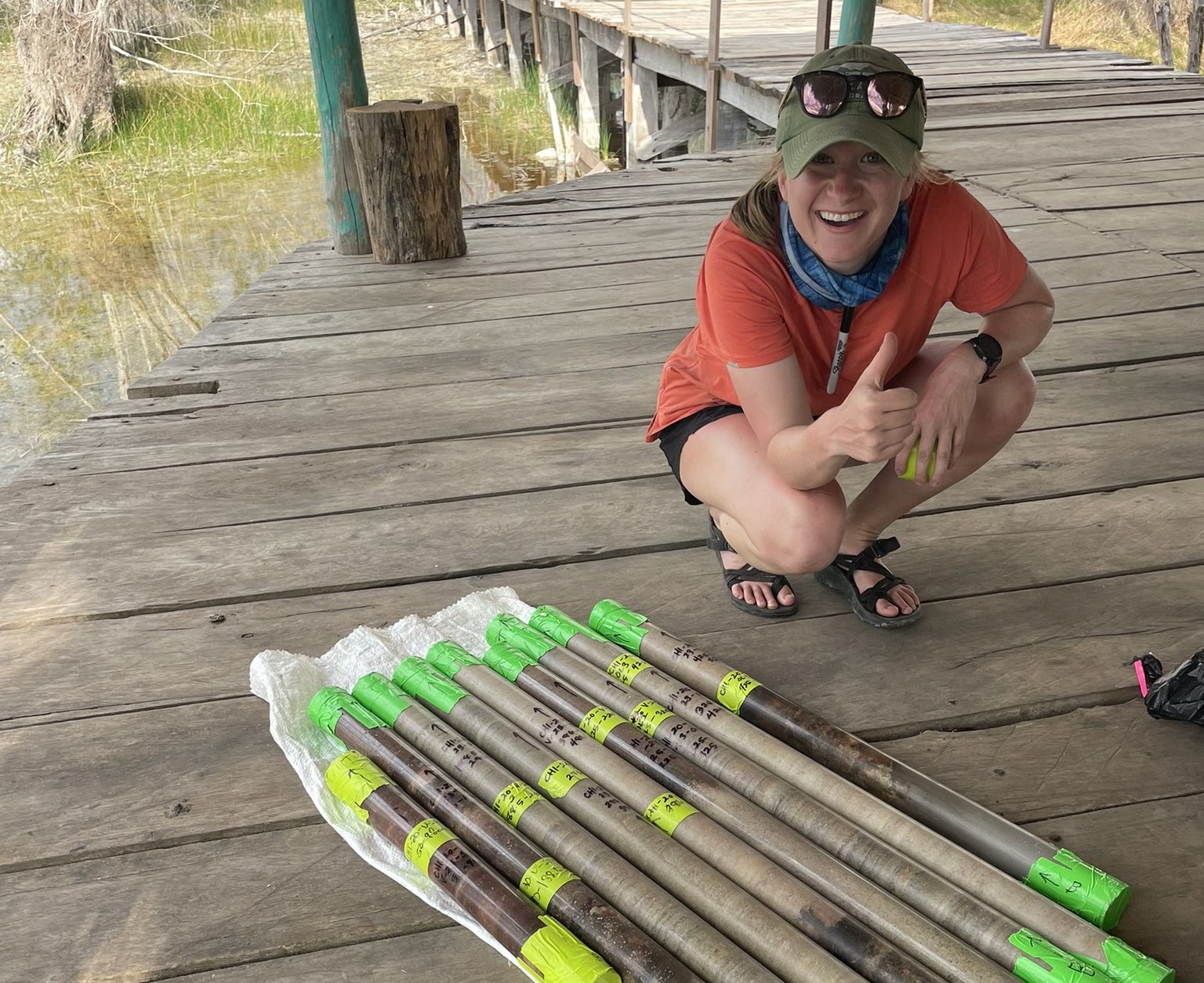
Savanna and the AU PaleoEnvironmental Lab at Chichén Itzá in Yucatan, Mexico
What do you find most motivating about your work?
There is a lot I find motivating about my research! But specifically, I enjoy knowing how my work “fits” into larger conversations about urbanization. Sediment cores are a relatively simple approach to acquiring really powerful – and otherwise absent – data that span an entire timeline of an urbanizing area. This opens the door for conversations with lake managers about drivers of change, successfulness of management approaches and whether urbanization looks the same from lake to lake. I’ve always been very curious and personally love science for the sake of science but more broadly believe that scientific research should be as applied as possible. So I’m glad that “paleo” allows me combine pure science with practical applications.

The PaleoEnvironmental Lab collected several sediment cores in Florida in 2022 – some to be used by Savanna for her dissertation!
What advice do you have for other students interested in pursuing natural resources?
Lots of the students I’ve mentored range from being very to vaguely interested in graduate school but many express nervousness at the idea. Since being at Auburn, I’ve observed that there is no requisite set of skills someone needs to be a successful graduate student, and instead a variety of different “types” of students can be successful in graduate school. It’s all about leveraging your strengths while understanding that your weaker areas will be developed along the way. If you are interested in a potential research project or have a discrete career goal that requires graduate training, there is probably a place in graduate school for you.
What are some of the biggest lessons you have learned since coming to Auburn?
While you’re a student or just beginning a career, get involved in a lot for little periods of time. One of the unique aspects of the natural resources field is that much of the work is seasonal. This affords students the opportunity to “sample” different parts of the profession (which is wide-ranging) to figure out what they like. Work in a lab for a semester, intern for a non-profit over a summer, work as a field tech for a season. All of this a) builds a nice resume/professional connections and b) helps refine what career path a student might want to pursue in a low-stakes way.

A cold trip to North Carolina to collect a sediment core
Who has been your greatest influence or role model in this field, and why?
Oh man. I don’t quite have the words to express what Matt Waters’ advisement and leadership has meant to me… but I’ll try. He is generous with his time, indulgent of students’ ideas and dynamic in the way he thinks about science. I’ve benefitted from all these attributes and am a better, more confident scientific thinker because of the hours logged in his office. He has also demonstrated that you can undertake serious science in a way that is lighthearted, adventurous and inclusive. Because of his example, I feel free to engage in scientific research on my own terms. Finally, he has a natural kindness and warmth. I’ve watched him treat students and famous scientists with identical levels of regard and interest. I hope to be learning from him and following his example for a long time.
What are your plans post-graduation?
I’m currently on the hunt for a postdoctoral researcher position. But beyond that plan to pursue a career in academia, hopefully researching and teaching at a small or midsized liberal arts college where I get to work alongside students all day.
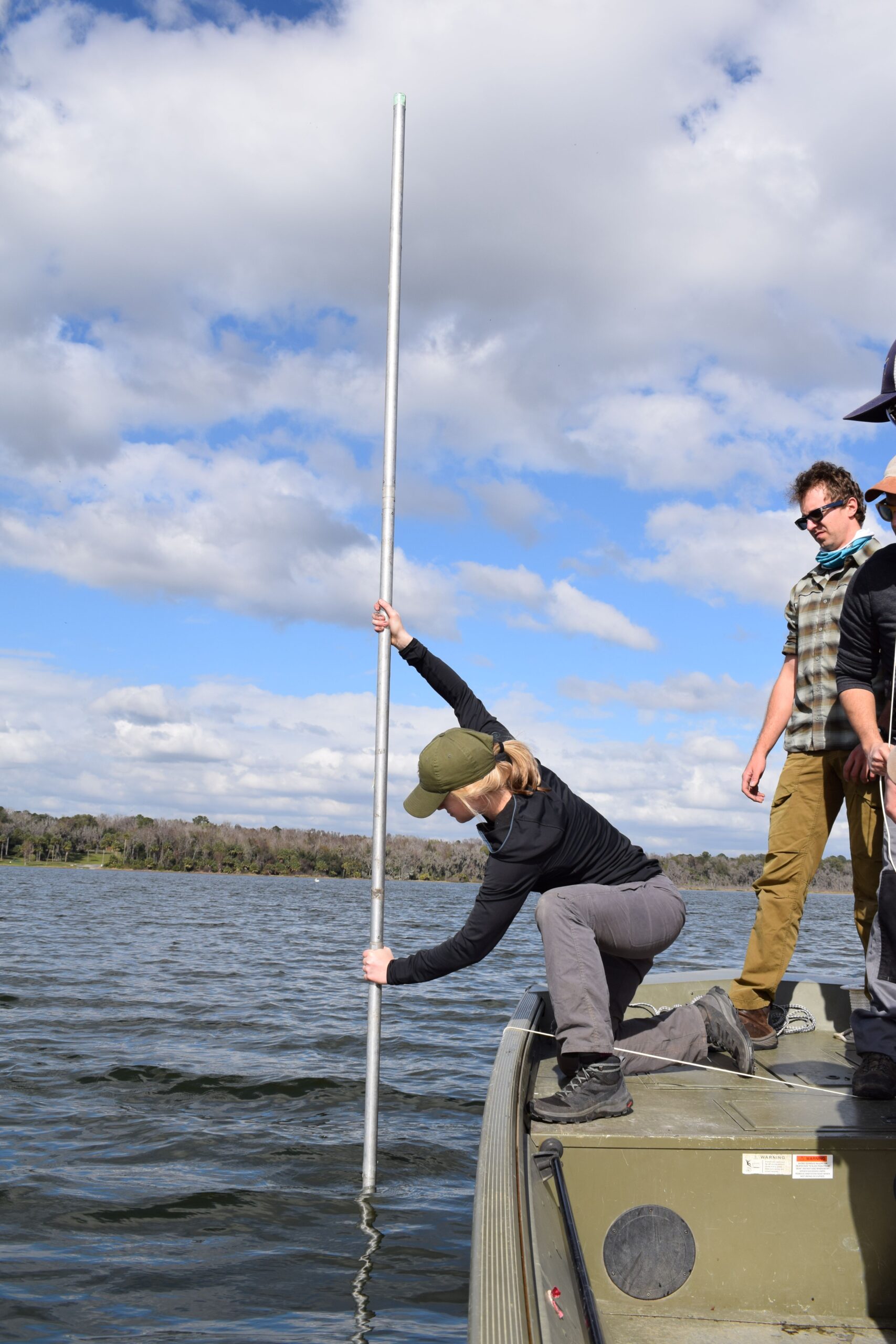
Savanna collecting one of her first sediment cores in Florida (2022)